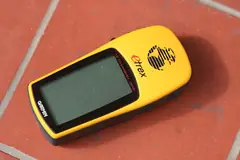
 Photo ForestWander, CC BY-SA 3.0 us

Pacing and judging distance
Knowing how far you have walked by counting your steps and watching the clock, so the map and the ground stay matched.
The words
- Pace: two steps, counted each time the same foot lands
- Pace count: how many paces it takes you to walk 100 metres
- Pace beads: a string of beads you slide along a cord, one for every 100 metres
What you need
- A measured 100 metres: a sports field, a running track, or two points you have measured on a road
- A topo map with a scale bar and grid squares
- Pace beads, a cord you can tie knots in, or a pocket of small stones
- A watch
How
- Find your pace count. Walk the measured 100 metres at your normal walk and count every time your left foot lands. Walk it three or four times and take the average. Most grown people land somewhere around 60 to 70.
- Do it again on rough ground, uphill, on snowshoes and with a loaded pack. Your count goes up on every one. Write the numbers down and keep them with the compass.
- Measure the leg on the map before you walk it. On a 1:50,000 topo map every grid square is one kilometre on a side, and 2 cm on the map is one kilometre on the ground.
- For a winding route, lay a piece of string or the edge of a sheet of paper along it, mark it, then lay it straight against the scale bar.
- Walk and count. Each time you reach your count for 100 metres, slide one bead down, tie a knot or move one stone from one pocket to the other, then start the count again at one.
- Keep a rough time as well. On a good trail you cover about 4 to 5 km in an hour. Through woods, bog or deep snow, plan on half that or less. Add about an hour for every 600 metres you climb.
- When your count says you should be at a pond, a brook or a bend, look for it. If it is not there, stop and check the map before you go on.
Do and don't
Do
- Check your pace count now and then. It changes with your legs, your boots and your load.
- Count in hundreds and let the beads keep the hundreds. It is easy to lose count past a hundred.
- Pace every leg of a bearing, and every detour around a pond or a cliff. See Taking and walking a bearing.
Don't
- Do not trust a count on a long leg. Small errors add up. Use features on the map to reset it.
- Do not plan on trail speed through tuckamore or bog. It will be slower than you think.
- Do not lose the count when you stop to rest. Slide a bead or say the number out loud first.
Watch for
Danger
- In fog, snow or the dark you feel you have walked farther than you have. Trust the count over the feeling.
- The rougher the ground, the worse the count. On blowdown, tuckamore and steep slopes, treat your distance as a rough guess and lean on the map features.
- Daylight: check the time against the distance left while there is still light to turn back or make camp. See When you are lost.
Notes
A compass tells you which way. Pacing tells you how far. You need both to know where you are on the map.
Put it together with Aiming off and catching features: pace to your attack point, then take the short careful leg in.
Updated 2026-09-29
Related
 Aiming off and catching features
Navigation
Missing your target on purpose so you know which way to turn, and picking a line on the map that tells you when you have gone too far.
 Taking and walking a bearing
Navigation
Map and compass to a place you cannot see from where you stand.
 Reading a topo map
Navigation
Seeing hills, valleys and bogs in the brown lines, and knowing how far a centimetre really is.
 GPS and phone navigation
Navigation
Using a phone or a GPS in the woods with no signal: maps saved before you go, battery kept alive, and the paper map still in the pack.