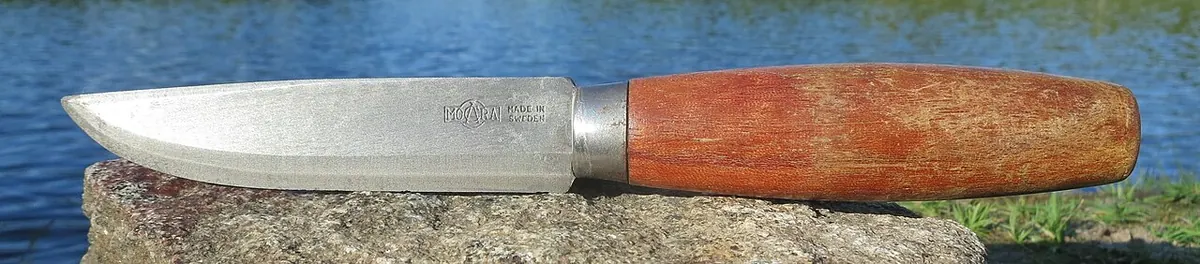
 Photo R. Henrik Nilsson, CC BY 4.0

Choosing a knife
The one knife that does most camp and field work, what to look for, and how to use it without cutting yourself.
What you need
- A fixed blade of about 10 centimetres with a full tang
- A sheath that holds it firmly and does not let the point through
- A small folder or multitool as a second knife
- A sharpening stone. See Sharpening a knife.
How
- Pick the size first. A blade of about 10 centimetres carves, cleans fish, dresses game and makes feather sticks. Longer is harder to control.
- Pick the tang. Full tang means the steel runs the whole length of the handle, the strongest build.
- Pick the steel. Carbon steel sharpens easily and throws sparks off a fire steel, but rusts. Stainless shrugs off wet and salt, but is slower to sharpen.
- Pick the grind. A flat Scandinavian grind is the easiest to sharpen in the field and bites well into wood.
- Pick the handle. It should fill your hand with gloves on and not get slippery when wet.
- If you carry a folder, get one with a lock that holds the blade open.
Do and don't
Do
- Cut away from your body, with your other hand behind the edge.
- Keep a clear circle around you, an arm and a blade long, when you work.
- Wipe and dry a carbon blade after use and give it a drop of oil.
Don't
- Do not use the knife as a pry bar or a screwdriver. Tips snap.
- Do not baton a folder through wood. Only a sturdy fixed blade takes that.
- Do not reach for a falling knife. Step back and let it drop.
Watch for
Danger
- Most camp cuts happen on the hand holding the work. Wear a glove on that hand for heavy carving.
- A dull knife slips and needs more force. Sharp is safer.
- A deep cut to the thigh or wrist can bleed fast. See Stopping bad bleeding.
Notes
A plain Mora style knife with a carbon blade is cheap, light and does almost everything. Many people carry one for years.
The best knife is the one you have on your belt when you need it, not the good one left in the truck.
Updated 2026-09-22
Related
 Batoning and feather sticks
Tools and Blades
Splitting small wood with a knife and a stick, and carving curls that catch a flame when everything else is wet.
 Carving camp gear
Tools and Blades
Tent pegs, a pot hook, a spoon and a pot lifter, made with a knife and a bit of wood.
 Sharpening a knife
Tools and Blades
Getting a working edge back with a stone and a bit of patience.
 Axe and saw work
Tools and Blades
Cutting wood without cutting yourself, and keeping the edges alive.