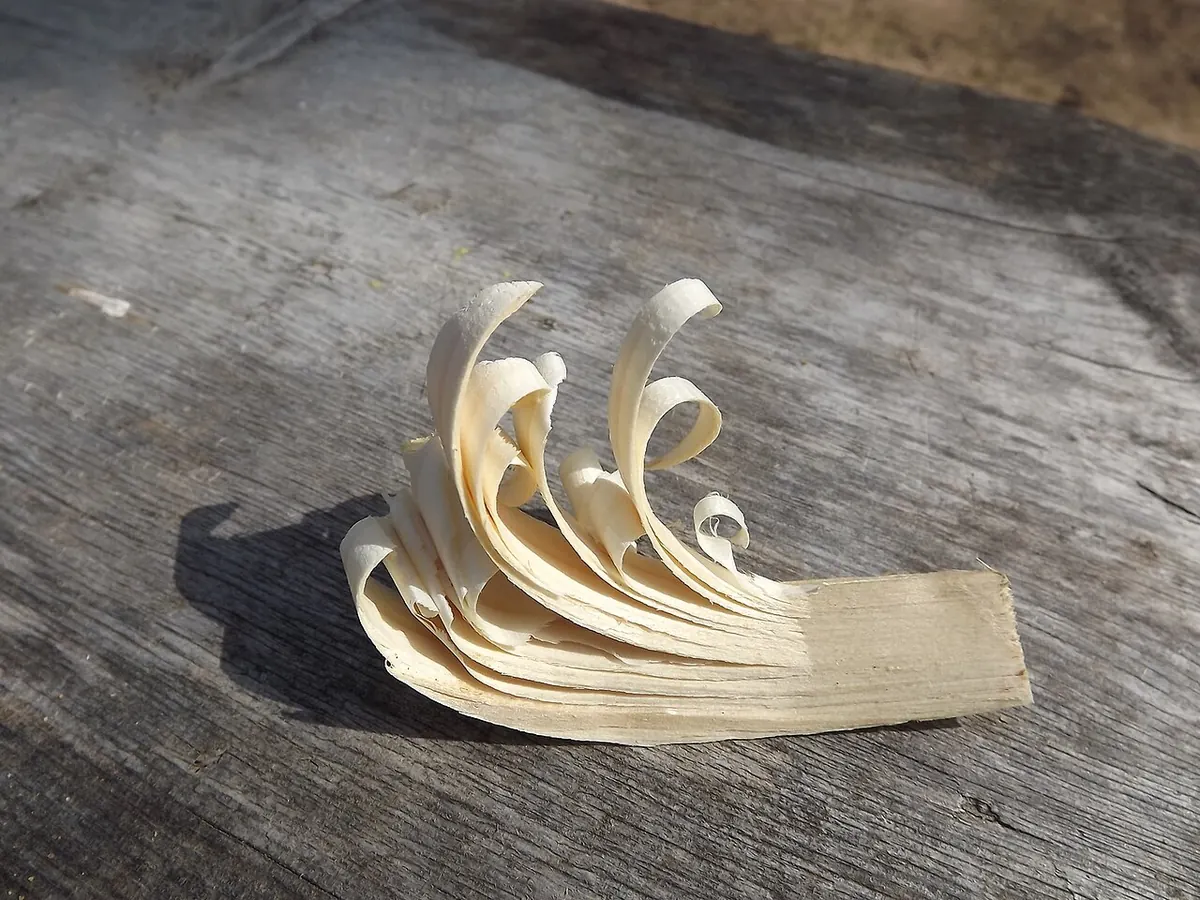
 Photo LPfi, CC BY-SA 3.0

Batoning and feather sticks
Splitting small wood with a knife and a stick, and carving curls that catch a flame when everything else is wet.
What you need
- A sturdy fixed blade knife, full tang. See Choosing a knife.
- A baton: a forearm length of hardwood, thick as your wrist
- Dead standing wood or dead branches, no thicker than your wrist
- A flat log or stump to work on
How
- Batoning: stand the piece of wood on end on the log, not on the ground.
- Set the knife edge across the top, with a hand width of blade sticking out past the far side.
- Strike the spine of the knife with the baton, close to the handle, until the blade is in.
- Now strike the part of the blade that sticks out past the wood, driving it down until the piece splits.
- Split the halves again. The dry wood is in the middle.
- Feather stick: take a dry split piece with no knots, about thumb thick.
- Hold it with the end on the log, angled away from you. Lock your knife wrist and push the blade down along the wood with your body, taking a long, thin curl.
- Stop the cut before the curl comes off, and start the next one beside it.
- Make a tight bunch of curls at the bottom of the stick. Light those.
Do and don't
Do
- Keep your free hand behind the blade, and your legs out of the line of the cut.
- Cut thin. Paper thin curls light, thick ones do not.
- Carve a few feather sticks before you strike a match.
Don't
- Do not baton through knots. Split around them.
- Do not baton with a folding knife.
- Do not hit the handle or twist the blade to pry the wood apart.
Watch for
Danger
- A blade that slips off the end of a split swings toward your legs. Kneel or keep them wide.
- Batoning big wood breaks knives. Use an axe for anything thicker than your wrist. See Axe and saw work.
Notes
A good bunch of feather curls and a few thin splits will light on one match in the rain. See One match fire.
The flat Scandinavian grind on a cheap bush knife carves feather sticks better than most expensive blades.
Updated 2026-09-22
Related
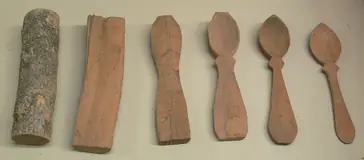 Carving camp gear
Tools and Blades
Tent pegs, a pot hook, a spoon and a pot lifter, made with a knife and a bit of wood.
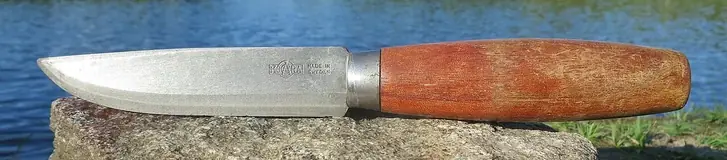 Choosing a knife
Tools and Blades
The one knife that does most camp and field work, what to look for, and how to use it without cutting yourself.
 Sharpening a knife
Tools and Blades
Getting a working edge back with a stone and a bit of patience.
 Axe and saw work
Tools and Blades
Cutting wood without cutting yourself, and keeping the edges alive.