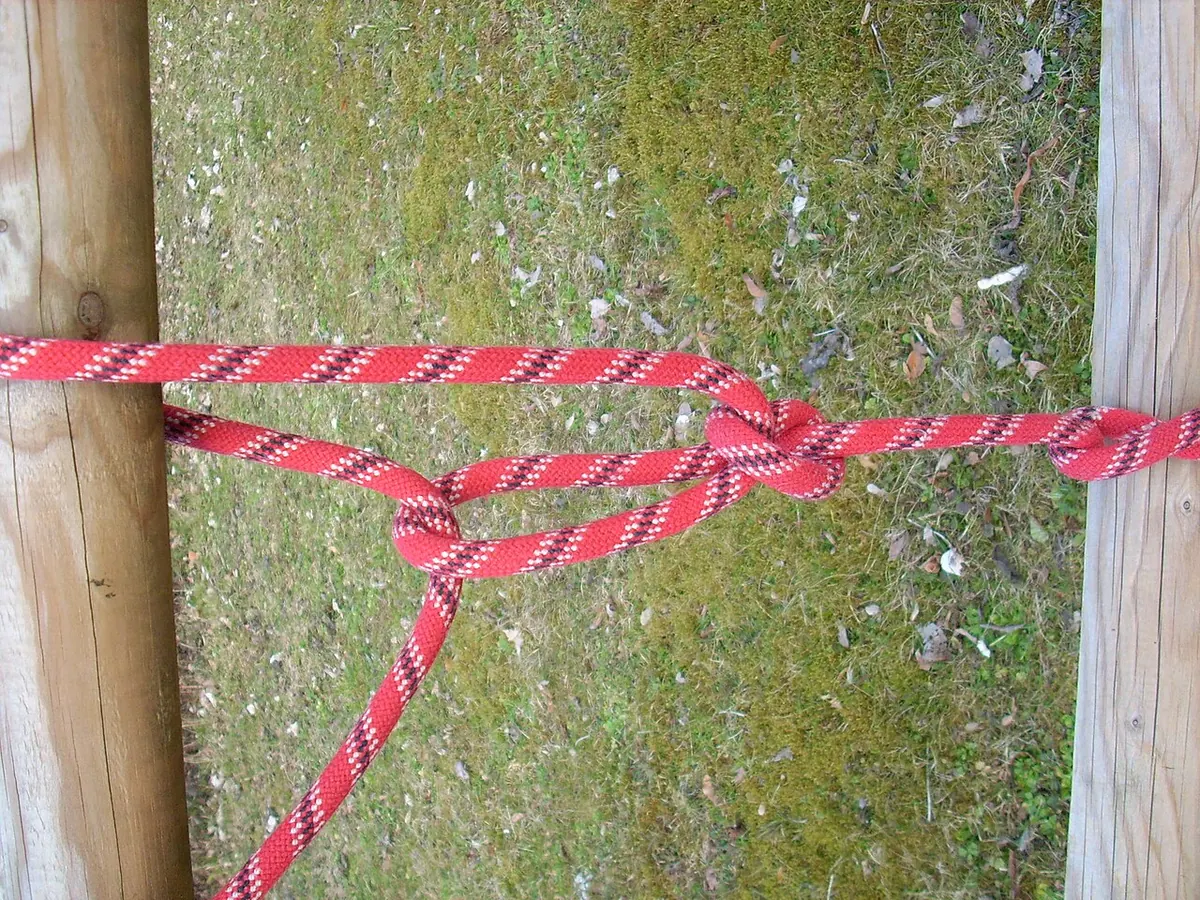
 Photo Markus Bärlocher, Public domain

Trucker's hitch
The rope pulley that cinches a load, a canoe or a ridge line drum tight and still lets go when you want it to.
What you need
- A rope tied off at one end to a tree, a rack or a tie point
- Something to pull against at the other end
- Gloves for heavy loads
How
- Tie the far end of the rope off to its anchor.
- Partway along the standing part, a little more than an arm's length from the near anchor, twist in a loop: a slipped overhand or an alpine butterfly.
- Run the tail around the near anchor, a tree, a rack bar or a truck hook.
- Bring the tail back up and pass it through the loop you made.
- Pull the tail down toward the anchor. The loop works as a pulley and gives you about three times the pull.
- Pinch the rope at the loop to hold the tension.
- Finish with two half hitches around the tight lines below the loop, or a slipped half hitch so it pulls free.
Do and don't
Do
- Use it for ridge lines, tie downs on a canoe or a truck load, and bear hangs.
- Tie the loop so it will not capsize. An alpine butterfly holds best.
- Finish with a slipped hitch on anything you will want to undo with cold hands.
Don't
- Do not use it to hold a person. It is for loads, not lives.
- Do not crank a canoe down so hard it deforms the hull.
- Do not tie the loop with a simple twist. It pulls out under load.
Watch for
Danger
- Rope running over rope makes heat and wears fast. Check for glazed or fuzzy spots on a line you use often.
- A loaded line that lets go comes back hard. Keep faces clear.
- Slippery modern cord can creep. Put an extra half hitch on it.
Notes
If you learn one knot after the bowline, make it this one. It is the difference between a tarp that sags by midnight and one that is still tight in the morning.
A carabiner in place of the loop runs smoother and wears the rope less.
Updated 2026-09-21
Related
 Bowline
Knots and Rope
The loop that will not slip and still unties after it has been loaded.
 Clove hitch and timber hitch
Knots and Rope
Two quick hitches for poles and logs: the clove hitch to tie off to a post and start a lashing, the timber hitch to drag a log out of the woods.
 Coiling and caring for rope
Knots and Rope
Coiling a rope so it comes off clean next time, sealing the ends, keeping it dry, and knowing when a rope is done.
 Joining two ropes
Knots and Rope
The sheet bend for a quick join that unties easily, and the double fisherman's for one that stays put.