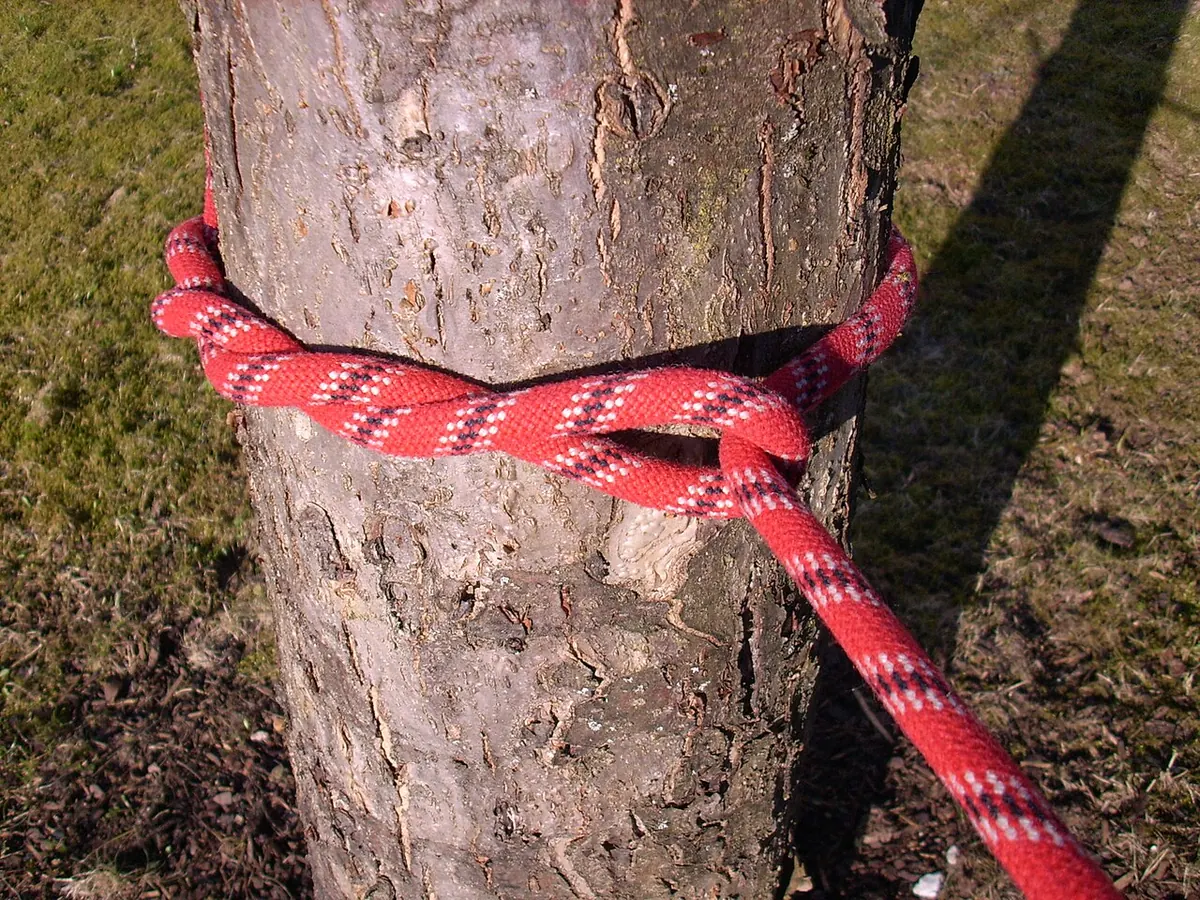
 Photo Markus Bärlocher, Public domain

Clove hitch and timber hitch
Two quick hitches for poles and logs: the clove hitch to tie off to a post and start a lashing, the timber hitch to drag a log out of the woods.
What you need
- Rope or cord that suits the job
- A pole, a post, a tree or a log
- Gloves for hauling logs
Clove hitch
- Take the rope around the pole.
- Bring the end across the front, over the standing part, and around the pole a second time.
- Tuck the end under that second turn, so the end and the standing part come out of the middle going opposite ways.
- Pull both ends to snug it. The two turns sit side by side with one diagonal across the front.
- Over the top of a post, make two loops in your hand, both turned the same way, lay the second behind the first and drop the pair over the post. That is a clove hitch in the middle of a rope in two seconds.
- For anything that will pull or swing, add a half hitch around the standing part to lock it.
Timber hitch
- Take the end around the log, then around the standing part.
- Twist the end back around its own part three or four times, the same way the rope is laid. More twists on a thick or slippery log.
- Pull on the standing part. The hitch closes on the log and holds on the twists alone.
- To drag a log, tie the timber hitch well back along the log, then throw a half hitch around the log near the front end. The log follows nose first instead of swinging across the trail. That pair is the killick hitch, the same one used to tie a stone killick to its line.
- When the pull comes off, the hitch falls open. Slack it and shake it off.
Do and don't
Do
- Start and finish a lashing with a clove hitch. See Tarp lines and lashings.
- Keep the hauling rope long enough that you are well clear of the log.
- Haul across a slope or from the side, never from below.
Don't
- Do not trust a clove hitch alone on a smooth pole, or on a pole that turns under the load. It works loose. Lock it with a half hitch.
- Do not wrap the rope around your hand or wrist to haul. Hold it in your fist so you can let go.
- Do not stand downhill of a log you are moving.
Watch for
Danger
- A clove hitch near the end of a post, pulled from the side, can roll right off the end.
- A timber hitch holds only under a steady pull. For a load that jerks, or goes slack and tight, use a round turn and two half hitches. See Knots that do everything.
- A log that catches on a stump and swings can take your legs out from under you.
- Never use either hitch to hold a person.
Notes
The clove hitch is the knot of lashings, fences and a boat tied to a post. The timber hitch is the woodcutter's knot: fast on, fast off, and it never jams however hard the pull.
Learn them with Bowline and the Trucker's hitch and there is very little in camp you cannot tie.
Updated 2026-09-29
Related
 Knots that do everything
Knots and Rope
Four more knots and you can rig near enough anything.
 Tarp lines and lashings
Knots and Rope
Getting a ridgeline tight and a load tied so it stays tied.
 Bowline
Knots and Rope
The loop that will not slip and still unties after it has been loaded.
 Coiling and caring for rope
Knots and Rope
Coiling a rope so it comes off clean next time, sealing the ends, keeping it dry, and knowing when a rope is done.