 Photo Markus Bärlocher, Public domain

Joining two ropes
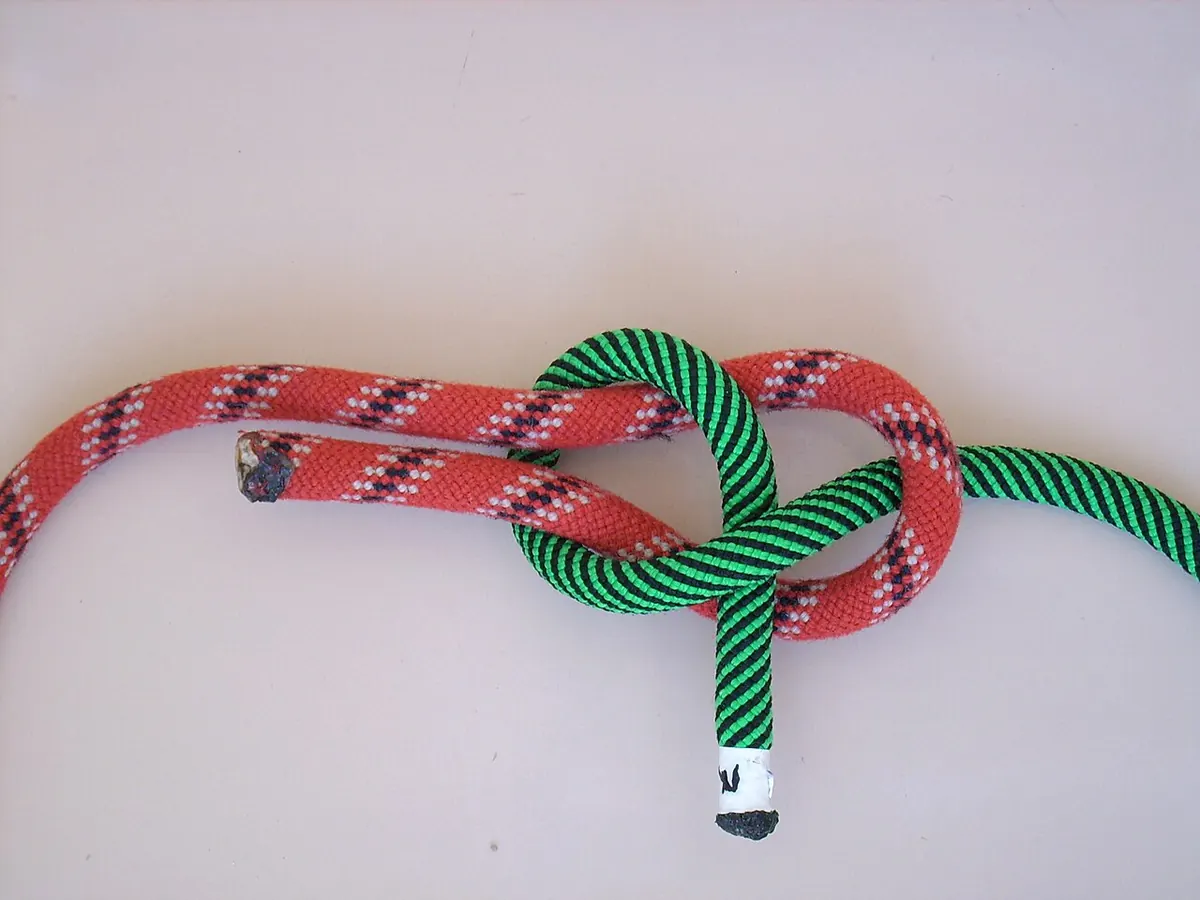
The sheet bend for a quick join that unties easily, and the double fisherman's for one that stays put.
What you need
- The two ropes or cords to join
- A few extra centimetres of tail on each
How
- Sheet bend: make a bight, a U shape, in the end of the thicker rope. Hold it in one hand.
- Pass the end of the thinner rope up through the bight from underneath.
- Take it around behind both legs of the bight.
- Tuck it under itself, across the front of the bight, not through it.
- Pull the standing parts to set it. Both tails should end up on the same side.
- For slippery or very different ropes, take a second turn around the bight before you tuck. That is the double sheet bend.
- Double fisherman's: lay the two ends side by side, pointing opposite ways.
- With one end, make two turns around the other rope, then pass it back through the turns. Do the same with the other end around the first rope.
- Pull the two knots together until they sit snug against each other.
Do and don't
Do
- Use a sheet bend to lengthen a guy line, a clothes line or a tarp line.
- Use a double fisherman's to close a loop of cord for a prusik. See Knots that do everything.
- Leave tails at least as long as a few rope widths.
Don't
- Do not join ropes with a reef knot or a granny for anything that carries a load. They slip.
- Do not use a joined rope where a person's life is on it unless you are trained to.
- Do not expect to untie a loaded double fisherman's. It is meant to stay.
Watch for
Danger
- A sheet bend can shake loose when it is not under load. Check it, or use the double.
- Tails that are too short pull through under load.
Notes
The sheet bend is the old net maker's knot and works with nearly anything, rope to rope, rope to a loop, even rope to the corner of a tarp.
If you remember nothing else, remember the tails end up on the same side.
Updated 2026-09-22
Related
 Coiling and caring for rope
Knots and Rope
Coiling a rope so it comes off clean next time, sealing the ends, keeping it dry, and knowing when a rope is done.
 Bowline
Knots and Rope
The loop that will not slip and still unties after it has been loaded.
 Clove hitch and timber hitch
Knots and Rope
Two quick hitches for poles and logs: the clove hitch to tie off to a post and start a lashing, the timber hitch to drag a log out of the woods.
 Knots that do everything
Knots and Rope
Four more knots and you can rig near enough anything.