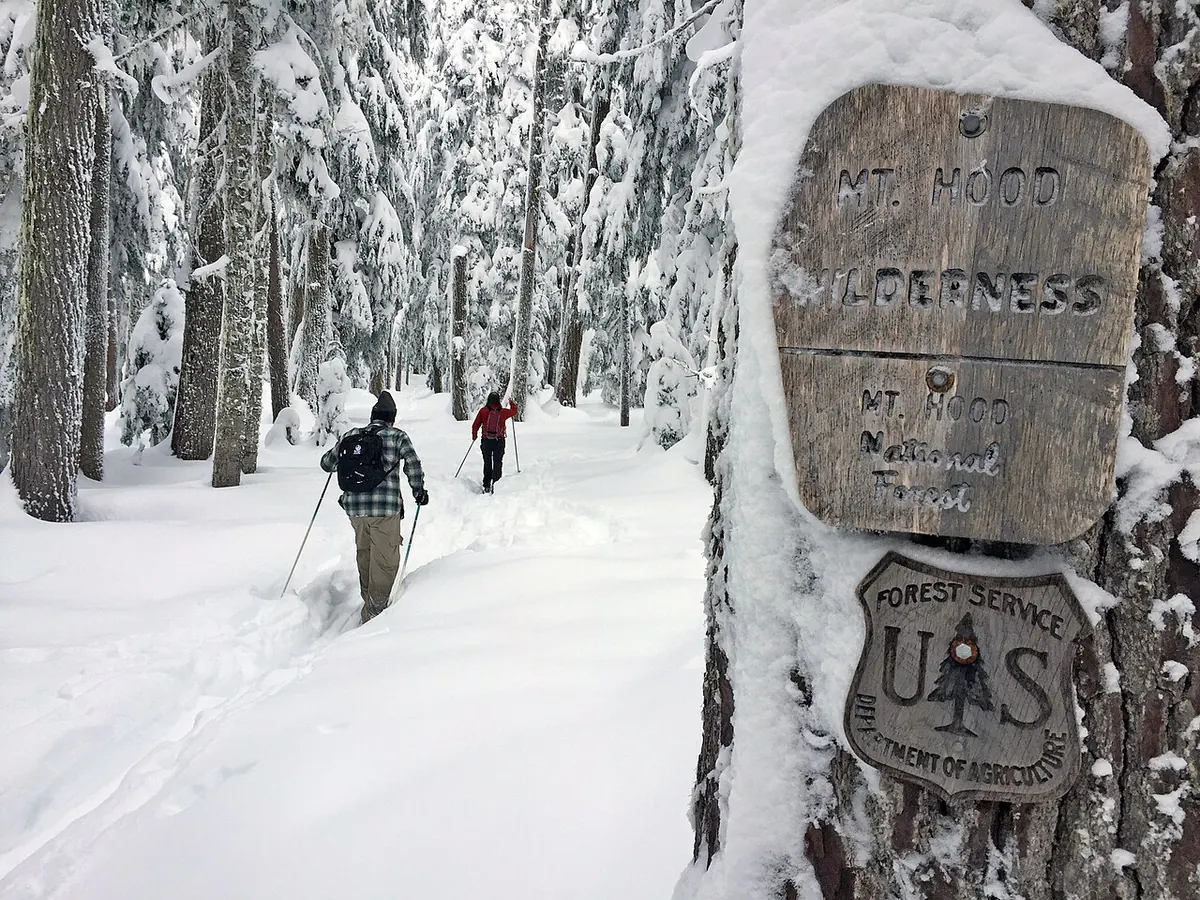
 Photo Forest Service, Public domain

Snowshoes and breaking trail
Picking a pair, strapping in, and moving through deep snow without wearing yourself out.
What you need
- Snowshoes sized for your weight plus your pack
- Bindings that fit your winter boots
- Two poles with snow baskets
- Gaiters to keep snow out of your boots
- A spare binding strap or a length of cord
How
- Size the shoe to the total load, you and the pack. Bigger floats better in powder, smaller turns better in the trees.
- Strap in at the trailhead with the ball of your foot over the pivot, so the tail drops when you lift your foot.
- Walk with your feet a little wider than normal so the frames do not clip each other.
- Take short, even steps. Lift the toe just enough to clear the snow and let the tail drag.
- Going uphill, kick the toe into the slope and use the heel lifts if you have them.
- Going downhill, lean back a little, keep your knees soft and plant your heels.
- On a side hill, kick the uphill edge in to make a step and keep your weight over it.
- Breaking trail with others, the leader works for ten minutes, steps aside and falls in at the back.
Do and don't
Do
- Try the bindings on at home with the boots you will wear.
- Go slower than you think. Deep snow takes two or three times the effort of a summer trail.
- Follow an old track when there is one. Packed snow saves you most of the work.
Don't
- Do not cross ponds or rivers on snowshoes you have not tested for ice. See Travelling on snow and ice.
- Do not step over a fallen log with both shoes at once. Put one down past it first.
- Do not sweat through your layers. Open up before you get hot.
Watch for
Danger
- A broken binding far from the truck turns a walk into wading. Carry a spare strap.
- Snow over brush and between rocks can hide holes deep enough to trap a leg.
- Deep snow on steep open slopes can slide. Stay in the trees or on low angle ground.
Notes
Old wooden bear paw and beaver tail shoes still work well in the soft snow of the Island's woods. Modern aluminium shoes with crampons grip better on hard crust and hills.
If you fall in deep snow, take the pack off first, then lay a pole flat on the snow and push on it to stand up.
Updated 2026-09-22
Related
 Hauling a toboggan
Winter and Cold
Pulling your gear on a sled instead of carrying it: how to load it, rig it and keep it from running you down on the hills.
 Snowmobile travel
Winter and Cold
Getting in and out of the country on a machine in winter, and what to carry when it quits miles from the truck.
 Travelling on snow and ice
Winter and Cold
Reading ice, breaking trail, and what to do when you go through.
 Keeping gear working in the cold
Winter and Cold
Batteries, fuel, water and zippers all quit before you do.