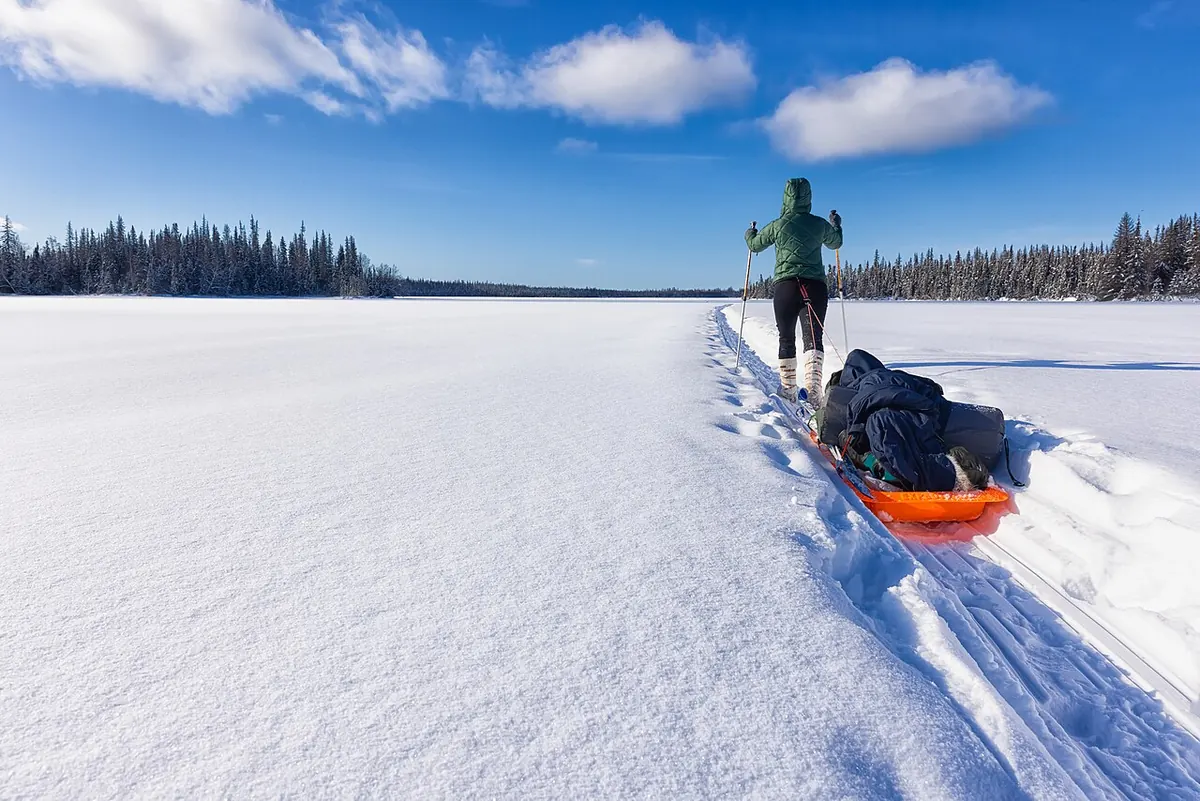
 Photo USFWSAlaska, Public domain

Hauling a toboggan
Pulling your gear on a sled instead of carrying it: how to load it, rig it and keep it from running you down on the hills.
What you need
- A toboggan or a plastic sled with a rim to hold the load
- A hip belt or a harness, so the pull comes on your hips and not your shoulders
- Stiff poles between you and the sled for hilly ground, or two ropes for flat going
- A tail rope on the back of the sled
- A tarp or a sled bag, and cord to lash the load down
- Snowshoes
How
- Load the heavy things low and in the middle, the light bulky things on top and at the ends. Keep it low and narrow and it will not roll.
- Wrap the load in the tarp and lash it tight. Anything that can shift will, and it tips the sled on every sidehill.
- Keep the things you want through the day on top where you can reach them: water, lunch, a dry layer, the axe.
- Break trail on snowshoes and let the sled follow in your packed track. In deep snow, take turns in front.
- Open your layers before you start. Hauling is hard work and sweat freezes the minute you stop. See Layering for cold.
- On a downhill, a partner holds the tail rope and brakes from behind. Alone, wrap a loop of rope under the front of the sled to drag in the snow, or walk it down beside you.
- On a steep climb, go at it in zigzags and short steps. Stop on the flat to rest, not on the slope.
Do and don't
Do
- Use stiff poles on hills. They hold the sled off your heels going down.
- Undo the hip belt before you cross ice you are not sure of, so you can get free of the sled if it goes through. See Travelling on snow and ice.
- Carry a spare length of cord and a few straps. Lashings wear through.
Don't
- Do not load more than you can pull up the worst hill on the route.
- Do not tie the pull rope to your wrist or around your hand.
- Do not stand below a loaded sled on a slope.
Watch for
Danger
- A loaded sled on a steep downhill can run into the back of your legs and knock you flat.
- Slush and overflow on a lake soak the bottom of the sled and freeze it solid to the load and the snow.
- A sled on a sidehill wants to roll. Cut a flat track across or go around.
- Sweat is the danger in winter hauling, not the cold. Wet clothes at the end of the day lead to hypothermia.
Notes
A sled lets you carry twice what you could on your back, and the weight stays off your spine and knees.
The same rules hold for a wood sled behind a snowmobile, only faster. See Snowmobile travel and Snowshoes and breaking trail.
Updated 2026-09-29
Related
 Snowshoes and breaking trail
Winter and Cold
Picking a pair, strapping in, and moving through deep snow without wearing yourself out.
 Snowmobile travel
Winter and Cold
Getting in and out of the country on a machine in winter, and what to carry when it quits miles from the truck.
 Travelling on snow and ice
Winter and Cold
Reading ice, breaking trail, and what to do when you go through.
 Keeping gear working in the cold
Winter and Cold
Batteries, fuel, water and zippers all quit before you do.