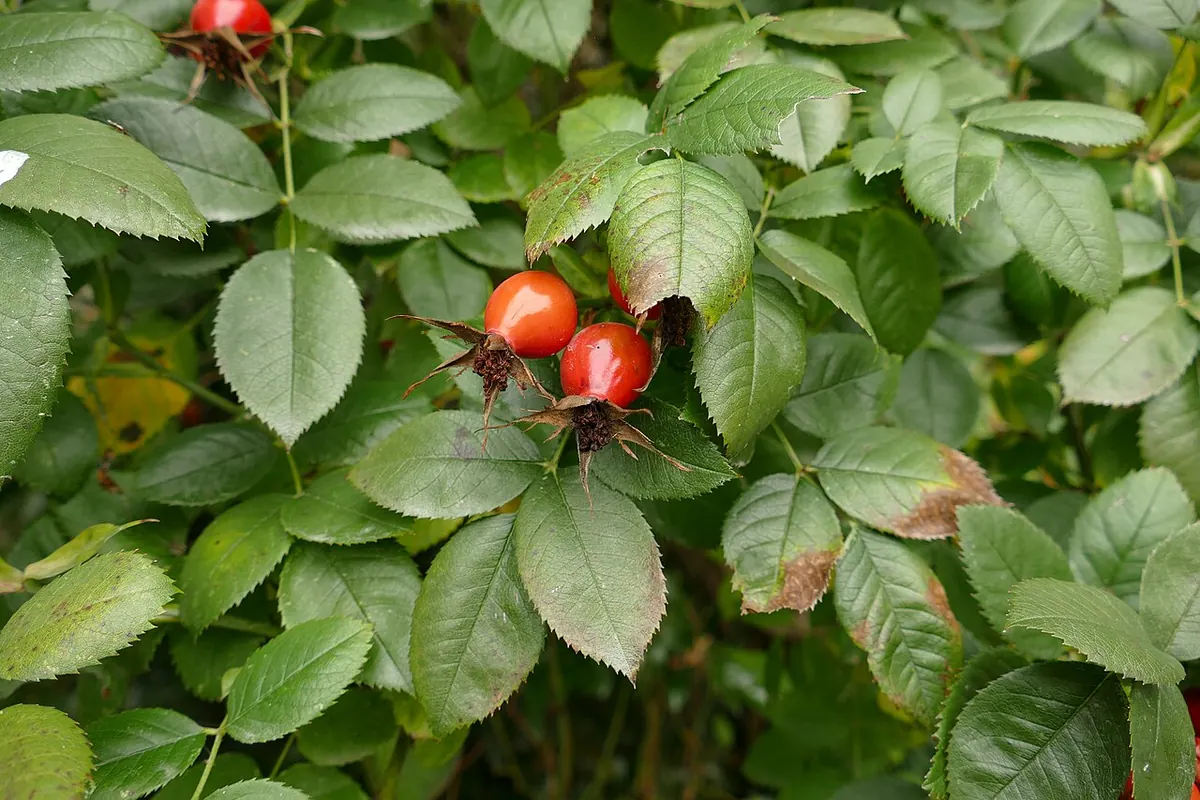
 Photo Kritzolina, CC BY-SA 4.0

Rose hips
The red fruit of wild roses: where to find them, when to pick, and getting the hairy seeds out.
What you need
- Leather gloves, for the thorns
- A bag or a bucket
- A small knife and a spoon
- A fine cloth or a coffee filter, for tea
How
- Know the bush. Wild roses are thorny shrubs with pink, five petal flowers in summer, along shores, barrens, roadsides and the edges of the woods.
- Wait for the fall. The hips turn bright red or orange, and after the first frost they soften and sweeten.
- Pick the ones that are full coloured and give a little when squeezed. Leave the shrivelled and the mouldy.
- Top and tail each hip, split it and scrape out the seeds and the hairs around them.
- For tea, crush a handful of hips, steep them in hot water for ten minutes or so, and pour it through a cloth to catch the hairs.
- Dry the cleaned halves on a tray somewhere warm and airy until they are hard, and keep them in a jar.
- The flesh makes a good jelly or jam with apples, and the hips hang on the bush into winter when little else does.
Do and don't
Do
- Pick where the land is clean, away from sprayed ditches and busy roads.
- Take a few from every bush and leave the rest for the birds.
- Strain everything through cloth. The hairs are the whole problem.
Don't
- Do not eat the seeds and hairs. They itch in the mouth and throat and upset the gut.
- Do not boil the tea hard for a long time. Steep it.
- Do not pick a red fruit unless it grew on a thorny rose bush.
Watch for
Danger
- Other red berries grow in the same places and some are poisonous. A rose hip grows on a thorny rose bush, is shaped like a small egg or ball, and is packed with hairy seeds inside.
- Thorns go through cotton gloves. Wear leather or pick slow.
- Damp hips go mouldy in a closed jar. Dry them hard first.
Notes
Rose hips are one of the richest wild sources of vitamin C, which is why they were picked through lean winters and in wartime.
See Plants to leave alone, Berries worth picking and Labrador tea.
Updated 2026-09-29
Related
 Cattails
Plants and Trees
The tall marsh plant with the brown seed head. Something to eat in every season, and fluff that catches a spark.
 Labrador tea
Plants and Trees
The low bog shrub with rusty wool under its leaves, how to be sure it is the right one, and how to make a weak, safe cup.
 Bark, moss and spruce gum
Plants and Trees
What the woods hand you for free: tinder, bedding, cordage, patching and a bit of rough medicine.
 Fiddleheads
Plants and Trees
The spring shoots of the ostrich fern: how to know them, how to pick them, and the cooking that keeps you from getting sick.