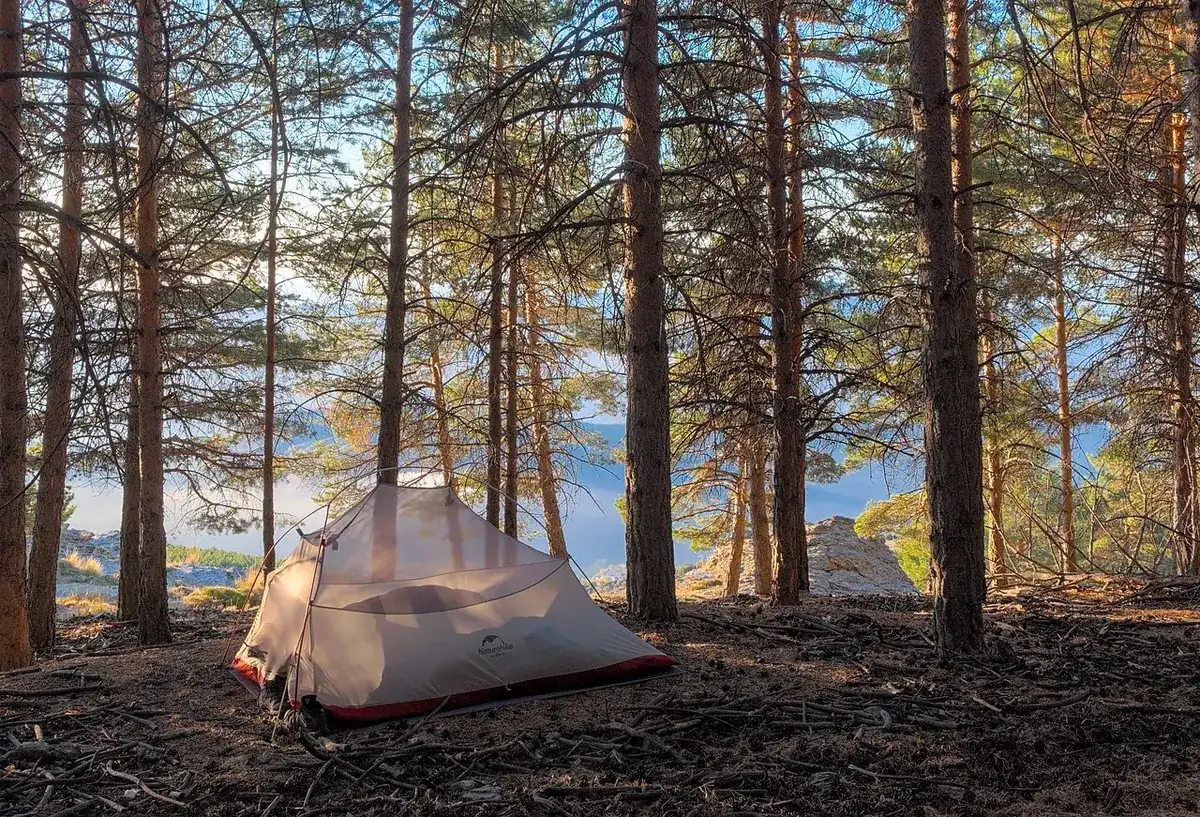
 Photo Trougnouf (Benoit Brummer), CC BY 4.0

Choosing a tent
What makes a tent stand up to our wind and rain, and how to pick the right size, weight and kind for the trips you actually take.
What to look for
- A fly that comes all the way to the ground on every side, not one that stops halfway down the walls
- A floor that turns up the sides a few inches before it meets the wall, so ground water cannot run in at the seams
- Aluminium poles. Fibreglass poles crack in the cold and splinter in the wind.
- Plenty of guy out points on the fly, at least one on each side and each corner
- A vestibule big enough to hold your boots and your pack out of the rain
- Two doors on a tent for two, so nobody climbs over anybody at night
- Taped seams on the fly and the floor
How
- Decide what it is for first. A tent carried on your back wants to be light. A tent that lives at a car camp or a boat camp can be heavier and roomier.
- Three season tents are made for spring to fall. A four season tent has stronger poles and less mesh and is made to carry snow and stand in a winter wind.
- Size up one. A two person tent holds two people snugly with no room for gear. For two people and their packs, look at a three person tent.
- Freestanding tents stand on their poles alone and are easier on rock and hard ground. They still need pegging and guying out in any wind.
- Lie down in it in the store if you can, with your sleeping pad, and check that your head and feet do not touch the walls.
- At home, pitch it in the yard before the first trip. Count the pegs and the poles and learn how it goes up in daylight.
- Seal the seams if the maker says to, and let the sealer dry fully before you pack it.
Do and don't
Do
- Buy longer pegs than the ones in the bag, and a few extra. Thin wire pegs pull out of bog and sand.
- Carry a groundsheet cut a little smaller than the floor so rain does not run between them.
- Dry the tent out at home after every trip before you put it away.
Don't
- Do not store a tent wet. It mildews in a few days and the coating starts to peel.
- Do not buy the lightest tent you can find for a windy coast. A few hundred grams saved is not worth a broken pole.
- Do not cook inside the tent.
Watch for
Danger
- A tent is not a winter shelter on its own. In the cold you need the right sleeping bag and pad under it. See Sleeping bags and pads.
- A stove, lantern or heater burning in a closed tent can kill you with carbon monoxide. Outside only.
Notes
The coast and the barrens here are windy almost every day. A low, rounded tent with a full fly and good guy lines will outlast a tall one with a bigger price tag.
See Pitching a tent in wind, and Picking a campsite, for putting it up once you have it.
Updated 2026-09-26
Related
 Boots and rain gear
Gear and Packs
The two pieces that decide whether a wet day is a nuisance or a rescue.
 Hammock camping
Gear and Packs
Sleeping off the ground: hanging a hammock level and safe, and keeping warm and dry in it.
 Natural shelter
Shelter
Using what is already standing: a rock overhang, a thick stand of tuckamore, the lee of a big spruce or the roots of a blown down tree.
 Packing a backpack
Gear and Packs
Where everything goes so the pack rides on your hips, stays dry, and gives you what you need without unpacking it all.