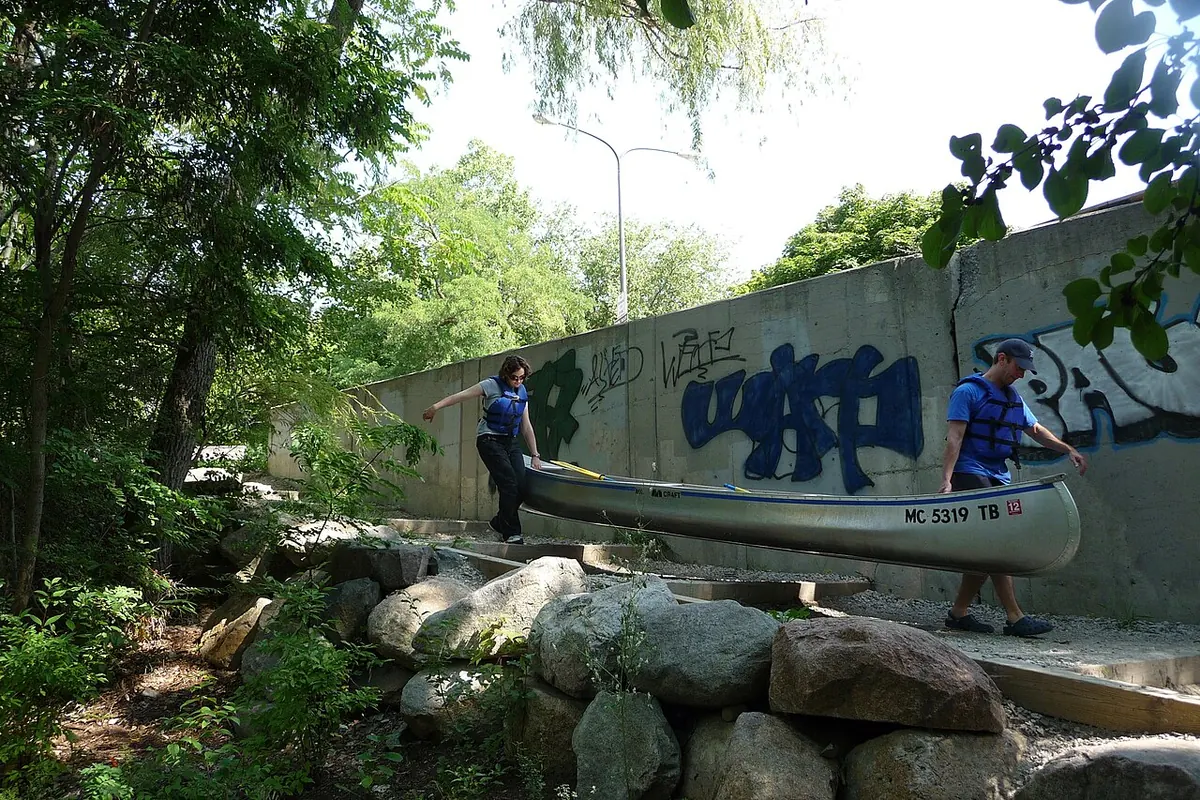
 Photo Rex Roof, CC BY 2.0

Portaging and lining
Getting the boat past what you cannot paddle: carrying it, or walking it through on ropes.
What you need
- A yoke or a pair of paddles lashed across the thwarts
- Painter lines, about 5 m on the bow and 5 m on the stern
- Two or three dry bags with proper straps, not loose gear
- Boots you do not mind soaking, with grip
- A throw bag where a hand can reach it
- Gloves, because wet rope through bare hands takes skin
How
- Scout first, on foot, before you commit the boat to anything you cannot see the end of.
- Unload on a flat spot at the landing. Carry the gear over first so you learn the trail with a pack, not with a boat on your head.
- Roll the canoe up to your thighs, then onto your knee, then over onto the shoulders with the yoke in place. Take the lift in stages and use your legs.
- Walk with the bow a little high so you can see the trail. Rest on a low branch or a rock rather than putting it down flat.
- To line down, stand on shore with the boat in the current, bow line long, stern line short, and let the current hold the boat out while you walk it down.
- To line up, reverse it: hold the bow in tight and let the stern swing out so the current pushes the boat away from shore.
- Keep both lines clear of your feet and never wrap a rope around a hand, a wrist or a waist.
Do and don't
Do
- Make two trips rather than one bad one.
- Keep the boat empty when lining. A loaded boat that pins is gone.
- Treat an unknown drop as a portage until you have walked it.
Don't
- Do not line a boat in water you could not swim out of.
- Do not stand downstream of a rope under load.
- Do not get between the boat and a rock in current. A pinned boat has tons behind it.
Watch for
Danger
- Foot entrapment: never stand up in moving water above your knees. If you are swimming, get on your back with your feet up and downstream.
- A boat that swings broadside in current will fill and pin in seconds. Let the rope go before it takes you with it.
- Wet rock, alders and a canoe on your shoulders is how ankles get broken. Slow feet.
Notes
Most of the trouble on a river trip happens at the two ends of a portage, not in the rapid.
A short carry you can walk twice beats a clever line down something you did not scout.
Updated 2026-09-20
Related
 Canoe strokes
Kayak and Canoe
The handful of strokes that keep a canoe going straight, turn it, and move it sideways to a dock or away from a rock.
 Lifejackets and boat kit
Kayak and Canoe
The PFD you actually wear, how it should fit, and the kit the law asks for in a canoe or kayak.
 Loading a canoe
Kayak and Canoe
Where the weight goes, how to tie it in, and how to get off the beach without swamping.
 Capsize and cold water
Kayak and Canoe
What cold water does to you, and how you get back in the boat.