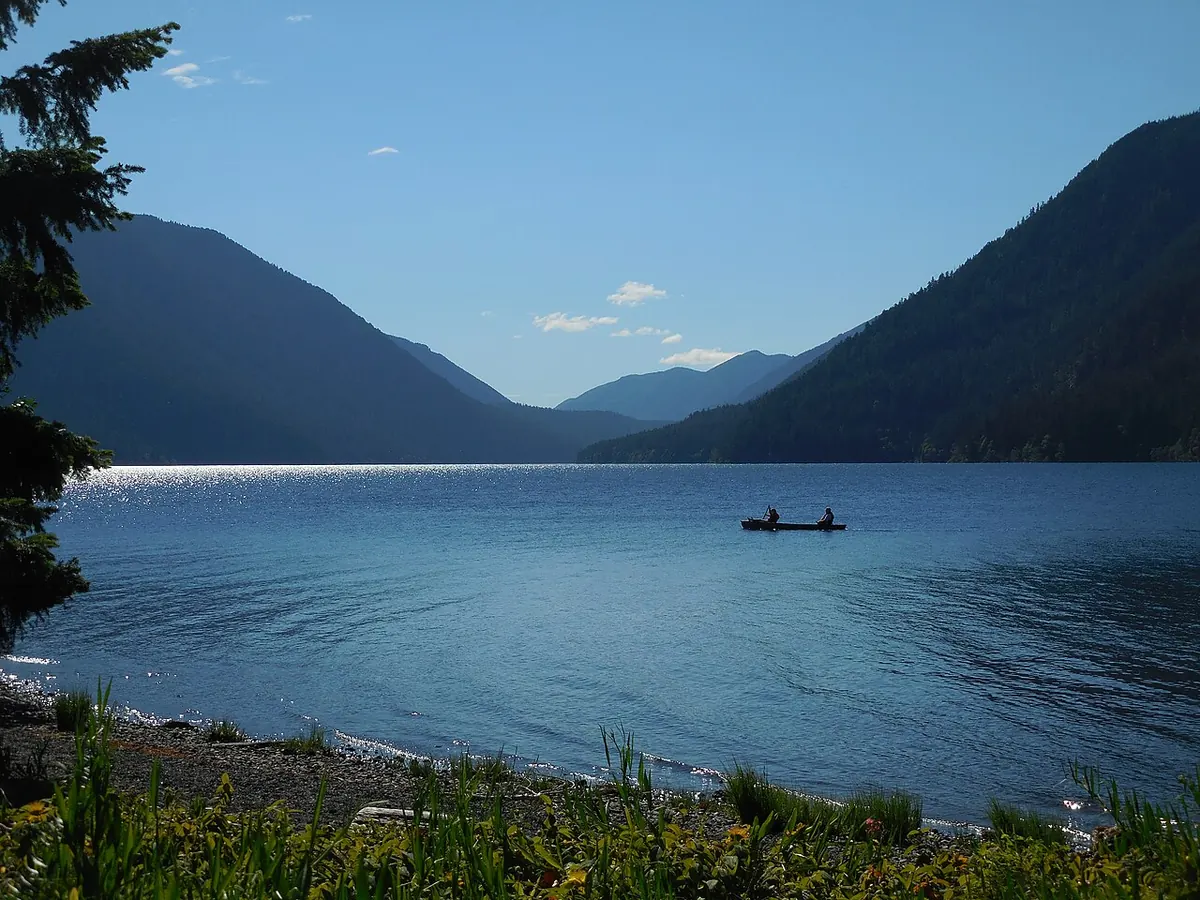
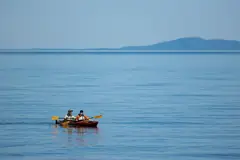
 Photo Olympic National Park, Public domain

Canoe strokes
The handful of strokes that keep a canoe going straight, turn it, and move it sideways to a dock or away from a rock.
What you need
- A paddle that reaches about your chin when it stands on its tip
- A PFD, done up
- A calm pond or sheltered cove to practise on
- A partner, or the canoe trimmed level for paddling alone
How
- Forward stroke: top hand over the grip, reach ahead, plant the whole blade, and pull back to your hip by turning your body, not your arms. Take it out at the hip.
- The bow paddler sets the pace. The stern paddler matches it and steers.
- J stroke: the stern paddler finishes the forward stroke by turning the top thumb down and pushing the blade out a little, like the hook on a J. It stops the canoe turning away from the stern side.
- Sweep: a wide arc from the bow out to the stern, far from the hull. It turns the canoe away from the paddle side.
- Draw: reach straight out to the side, plant the blade parallel to the canoe, and pull the water toward you. The canoe slides toward the paddle.
- Pry: slice the blade in against the hull and lever it away. The canoe moves away from the paddle.
- To switch sides together, the stern calls it and both change on the same stroke.
- To stop, plant the blade and hold it, or paddle backward.
Do and don't
Do
- Keep your weight low and in the middle.
- Use your stomach and back to paddle. Your arms tire first.
- Practise the draw and pry beside a dock before you need them beside a rock.
Don't
- Do not stand up in a canoe.
- Do not grab the gunwales when the boat tips. Keep your weight centred and let the hull move.
- Do not lean out to reach something. Paddle to it.
Watch for
Danger
- Wind catches a canoe like a sail. Stay near shore when it is up. See Reading a forecast.
- Cold water kills fast. Wear the PFD every time. See Capsize and cold water.
- A paddle pinched between the canoe and a rock can throw you out. Let go of it.
Notes
A good J stroke is the difference between a straight line across the pond and a zig zag that takes twice as long. It takes a season to feel natural.
Paddling alone, kneel just behind the centre thwart and lean the canoe slightly toward your paddle side. It turns into a whole different boat.
Updated 2026-09-22
Related
 Lifejackets and boat kit
Kayak and Canoe
The PFD you actually wear, how it should fit, and the kit the law asks for in a canoe or kayak.
 Loading a canoe
Kayak and Canoe
Where the weight goes, how to tie it in, and how to get off the beach without swamping.
 Portaging and lining
Kayak and Canoe
Getting the boat past what you cannot paddle: carrying it, or walking it through on ropes.
 Capsize and cold water
Kayak and Canoe
What cold water does to you, and how you get back in the boat.