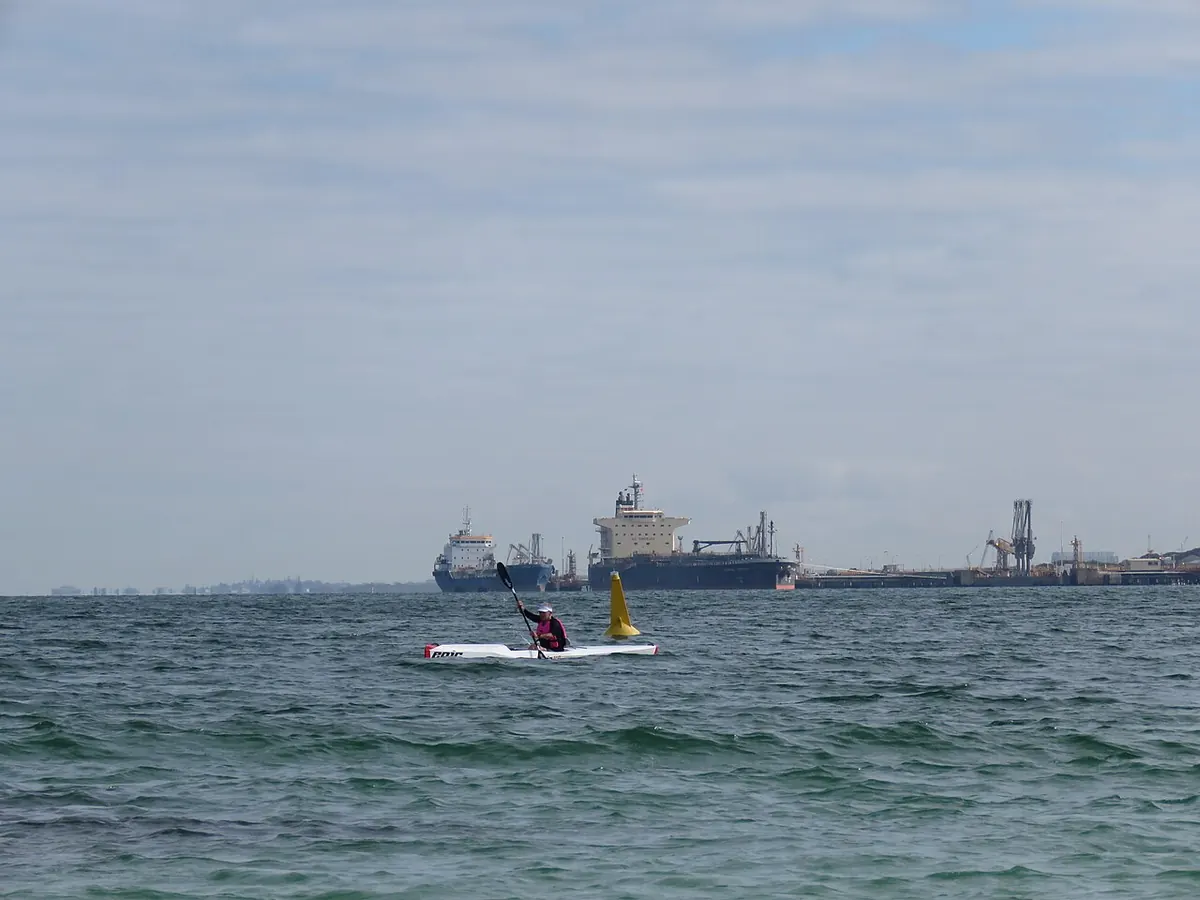
 Photo Calistemon, CC BY-SA 4.0

Paddling a kayak
The strokes, the brace and the rescues that let you take a kayak along the shore and get back in when it goes over.
What you need
- A lifejacket or PFD, worn and zipped, never stowed
- A paddle, and a spare broken down on the deck for any trip past the beach
- A spray skirt that fits the cockpit, with the grab loop outside
- A bilge pump and a paddle float
- A whistle on the PFD
- Clothes for the water temperature, not the air: a wetsuit or drysuit when the water is cold
- A dry bag with a warm layer, food, a light and a phone or radio
How
- Sit up straight with your feet on the pegs and your knees braced lightly under the deck. The kayak is steered with the whole body, not the arms.
- Forward stroke: plant the blade near your feet, turn your torso to pull it back to your hip, and lift it out. Push with the top hand as much as you pull with the bottom one.
- Sweep stroke to turn: a wide arc from the bow to the stern on one side turns the boat away from that side.
- Draw stroke to move sideways: reach out, plant the blade, and pull the boat to it, slicing the blade out before it hits the hull.
- Low brace: when the boat tips, slap the back of the blade flat on the water on the low side and snap your hips to bring the boat back under you.
- Wet exit: if you go over, tuck forward, pull the grab loop off the skirt, and push the boat away from you with your hands on the cockpit rim. Hold on to the boat and the paddle.
- Assisted rescue: a partner lays your boat across their cockpit to drain it, then holds it side by side while you climb back in over the back deck, belly first, then swing your legs in.
- Paddle float rescue on your own: float on one blade, the other blade under the deck lines behind the cockpit as an outrigger, then climb onto the back deck along the paddle and slide in.
- Practise every rescue in warm, shallow water with a partner before you ever need one for real.
Do and don't
Do
- Paddle with at least one other boat, and stay close enough to talk.
- Plan the trip around the wind: go out into it and come home with it behind you.
- Stay close to the shore and know where you can land along the whole route.
- Leave a trip plan with someone ashore.
Don't
- Do not go out in a kayak you cannot get back into.
- Do not paddle past a headland you have not seen from the land. Swell and wind change around it.
- Do not tie yourself or the paddle to the boat with a line that can wrap you in a capsize.
Watch for
Danger
- Our water is cold enough all year to take your strength in minutes. Dress for a swim every time. See Capsize and cold water.
- Waves bouncing back off a cliff meet the incoming ones and make a confused, steep sea. Stand well off cliffs in any swell.
- An offshore wind feels calm near the beach and gets stronger the farther out you go. It can blow you out to sea.
- Fog can close in fast along the coast. Carry a compass and know your bearing home. See Fog and coastal wind.
Notes
A kayak sits low and is hard for a boat to see. Wear bright colours, carry a light, and keep clear of the lanes where boats come and go from the wharf.
Transport Canada lists the safety kit a kayak must carry in the Safe Boating Guide. Check it before the season, because the list changes with the length of the boat.
Updated 2026-09-26
Related
 Capsize and cold water
Kayak and Canoe
What cold water does to you, and how you get back in the boat.
 Lifejackets and boat kit
Kayak and Canoe
The PFD you actually wear, how it should fit, and the kit the law asks for in a canoe or kayak.
 Loading a canoe
Kayak and Canoe
Where the weight goes, how to tie it in, and how to get off the beach without swamping.
 Canoe strokes
Kayak and Canoe
The handful of strokes that keep a canoe going straight, turn it, and move it sideways to a dock or away from a rock.