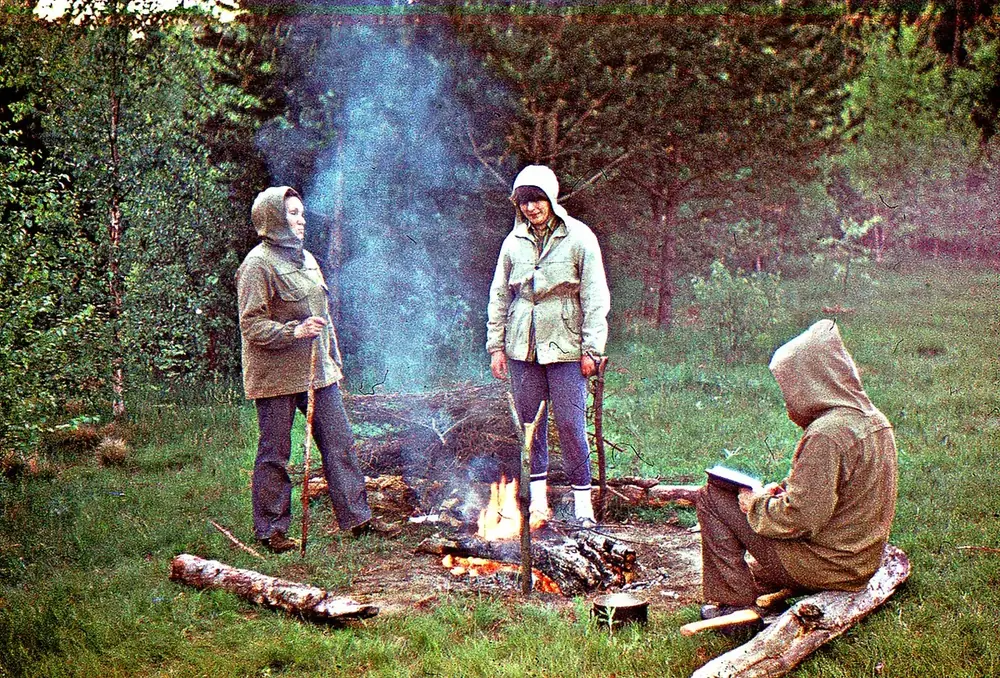
 Photo Vitold Muratov, CC BY-SA 4.0

Fire in wet weather
Getting a fire going when it has rained for three days and everything on the ground is soaked.
What you need
- A knife that will split and carve
- Birch bark, dead spruce twigs from under the tree, or fatwood
- Tinder you carried in, dry in a bag: cotton balls with petroleum jelly, or fire cubes
- A lighter and a ferro rod, both
- A few sticks of wrist thick dead standing wood
- Something for a floor: bark slabs, green poles, or a flat rock
How
- Pick your spot out of the wind and under cover if there is any. A big spruce or the lee of a rock keeps the rain off while you work.
- Build a floor first. Lay a row of wrist thick sticks side by side so the fire never touches wet ground.
- Gather more than you think you need, in three piles: tinder, pencil lead to pencil thick, and thumb to wrist thick. Keep it under your jacket or on a tarp.
- Take wood from dead standing trees and dead branches still on the tree, never off the ground. Snap test it: dry wood cracks, wet wood bends.
- Split the thicker sticks. The outside is wet, the heart is dry.
- Carve feather sticks from the dry heartwood: long thin curls left attached at the bottom. Three or four good ones will light off a spark.
- Light the tinder, feed the finest dry curls and twigs, and wait. Add the next size only when the flames are standing up tall on their own.
- Once it is going, lay the wet wood around the edges to dry before it goes on.
Do and don't
Do
- Carry dry tinder in a sealed bag every trip, rain or not.
- Keep your hands and the lighter dry inside a pocket until the moment you strike.
- Use birch bark wet or dry. The oil in it burns either way.
Don't
- Do not smother a small flame with a big wet stick.
- Do not blow hard on a young fire. A slow steady breath at the base is enough.
- Do not build under a low branch loaded with snow or water.
Watch for
Danger
- Cold hands lose skill fast. Get the fire lit before your fingers stop working, not after.
- Never use gasoline or stove fuel to start a wet fire. It flashes and burns the person, not the wood.
- A fire under a tarp melts the tarp and fills it with smoke. Keep the flames well out from the edge.
Notes
Rain is not the problem. Wet ground and wet small wood are. Get off the ground and get to the dry heart of the wood and most fires will go.
The spruce twigs at the bottom of the trunk, under the living branches, are dead, thin and sheltered. They are the best wet day kindling on the Island.
Updated 2026-09-21
Related
 Fire without matches
Fire
Getting a flame when the matches are gone or soaked.
 One match fire
Fire
Getting a fire lit on the first match in wet woods.
 A fire reflector
Fire
A wall of green logs or a rock face behind the fire, so the heat comes back to you and your shelter instead of into the woods.
 Fire safety in camp and at the cabin
Fire
Alarms, an extinguisher, two ways out, and what to do in the first minute when a tent, a pot or a cabin catches.