Wolf Wilds › Animals and Tracks
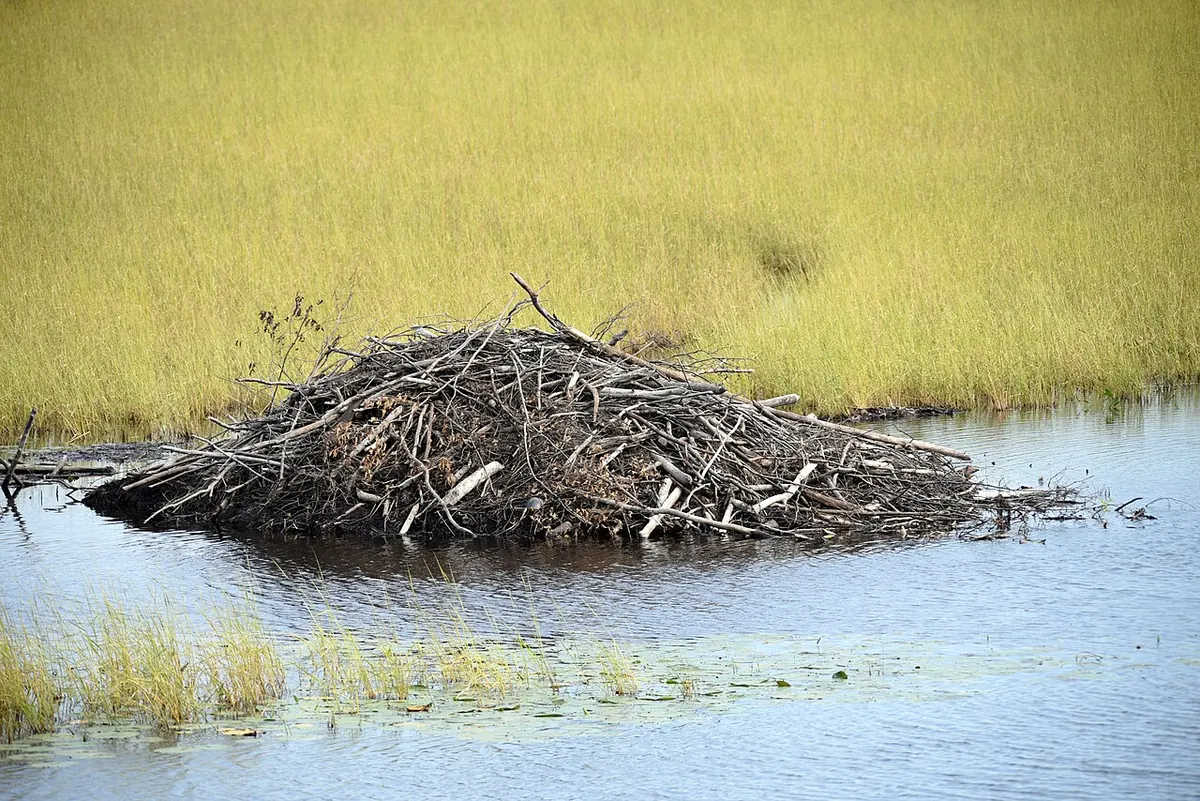 Photo U.S. Fish and Wildlife Service, Midwest Region, Public domain

Beavers and beaver ponds
What beavers do to a stretch of country, and how their dams, ponds and lodges can help you or get in your way.
Signs they are here
- Stumps chewed to a point, with fresh chips around them
- Peeled sticks floating at the water's edge
- A dam of sticks and mud across a brook
- A lodge, a dome of sticks and mud, out in the pond or on the bank
- Slides of flattened mud where they go in and out of the water
- A loud slap on the water at dusk. That is a tail, warning the others.
How
- Expect trails and old roads on your map to be under water where beavers have moved in.
- Walk around a beaver pond rather than across the dam. Dams are slick and can give way under you.
- Look below the dam for the outlet brook if you want moving water.
- Treat every drop of water from a beaver pond before you drink it, however clear it looks. See Making water safe.
- Give a swimming beaver room in a canoe. It will slap and dive.
- Use what a pond gives: flat water to paddle, trout in the deep holes, and dry standing dead wood around the old edges.
Do and don't
Do
- Keep dogs away from beavers in the water.
- Look up before you walk under a half chewed tree. It can come down.
- Check the height of the water at your cabin or campsite after a new dam goes in.
Don't
- Do not tear out a beaver dam. It can send a wall of water downstream, and you may need a permit.
- Do not walk out on the ice of a beaver pond near the lodge, the dam or the channels.
- Do not pitch a tent right below a dam.
Watch for
Danger
- Beaver fever. Giardia lives in water where beavers and other animals live, and it can make you sick for weeks.
- Ice near a lodge, a dam or a feed pile stays thin all winter because the beavers keep the water moving. See Travelling on snow and ice.
- A cornered or sick beaver can bite hard. Leave it be.
Notes
Beavers are the biggest rodent in North America and they reshape whole valleys. A new dam can flood a trail, a woods road or a cabin path in one season.
Old beaver meadows, where a pond has drained and grown in with grass, make for open walking and are good places to see moose.
Updated 2026-09-28
Related
 Blackflies, mosquitoes and ticks
Animals and Tracks
The small animals that ruin more trips than bears do, and how to keep them off you.
 Coyotes and foxes
Animals and Tracks
The two wild dogs you will meet here, how to tell them apart, and what to do when one comes too close to you, your camp or your dog.
 Keeping animals out of camp
Animals and Tracks
Food, smell and where you put them: the whole of it. Bears, foxes, jays and mice all read the same sign.
 Moose and bear
Animals and Tracks
What to do when you meet the two that matter on this island.