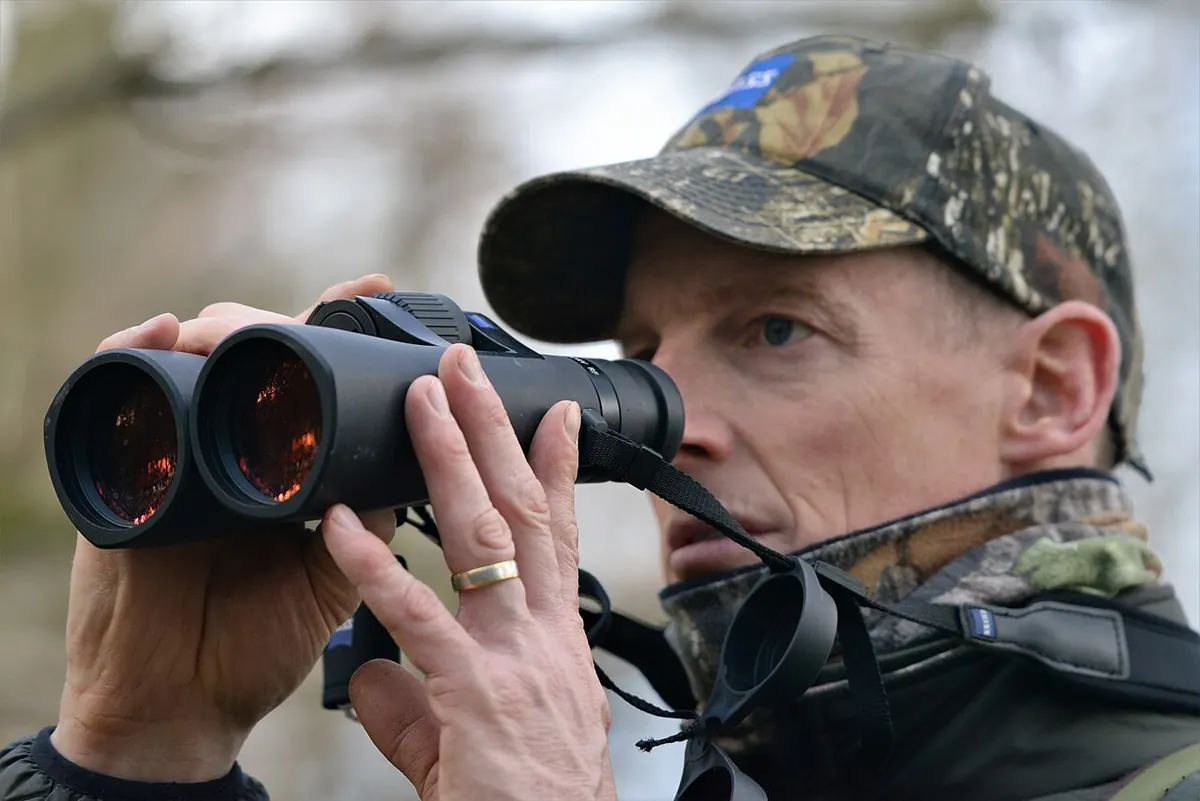
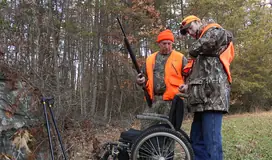
 Photo FieldsportsChannel.tv, CC BY 2.0

Still hunting and glassing
Moving slow through the woods and working the country with binoculars, so you see the animal before it sees you.
What you need
- Binoculars, 8 or 10 power
- A harness or strap that keeps them on your chest
- Quiet clothes, wool or fleece, with blaze orange where the law requires it
- Something to check the wind: fine powder, a thread, or a bit of milkweed
- A sit pad
How
- Check the wind first and keep it in your face or across it. Moose and deer smell you long before they see you.
- Move a few steps, then stop and look for longer than you walked.
- Look for parts, not the whole animal: a flicker of an ear, a leg, a straight back line, a patch of the wrong colour.
- Pick a spot with a view: a knoll over a bog, an edge of a cutover, a pond shore.
- Sit, brace your elbows on your knees, and glass in a grid. Left to right in strips, near to far.
- Glass the edges of openings hardest. Animals come out of cover and go back into it.
- Go again at first light and last light, when moose and caribou move most.
- When you see an animal, stop, make a plan, and close in with the wind right and cover between you.
Do and don't
Do
- Be sure of your target and what is beyond it before you ever raise the rifle.
- Use the binoculars, not the rifle scope, to look at anything.
- Know the legal hunting hours and your zone. See Seasons.
Don't
- Do not point a scope at something you cannot yet identify. It could be a person.
- Do not walk the skyline. Stay below the top of a ridge.
- Do not rush the last hundred metres.
Watch for
Danger
- Other hunters are in the same country. Wear your orange and never shoot at sound or movement.
- Glassing late means walking out in the dark. Carry a light and know your way back.
- A cow moose with a calf, or a startled bull in the rut, can charge. Give them room.
Notes
More moose are seen from a good seat with binoculars than by walking. The walking gets you to the seat.
The same slow way of moving works for watching animals with no rifle at all.
Updated 2026-09-22
Related
 Calling moose
Hunting
Bringing a bull to you in the rut with a cow call, a grunt and a bit of noise in the brush, and where to sit while he comes.
 Field dressing
Hunting
Getting the animal opened, cooled and clean before the meat turns.
 Hanging and cooling meat
Hunting
Getting the heat out of an animal fast and keeping the meat cool, clean and dry until it is cut up.
 Hunter orange and being seen
Hunting
Being seen by other hunters is the cheapest safety there is. What to wear, and how to move and carry game in the fall woods.