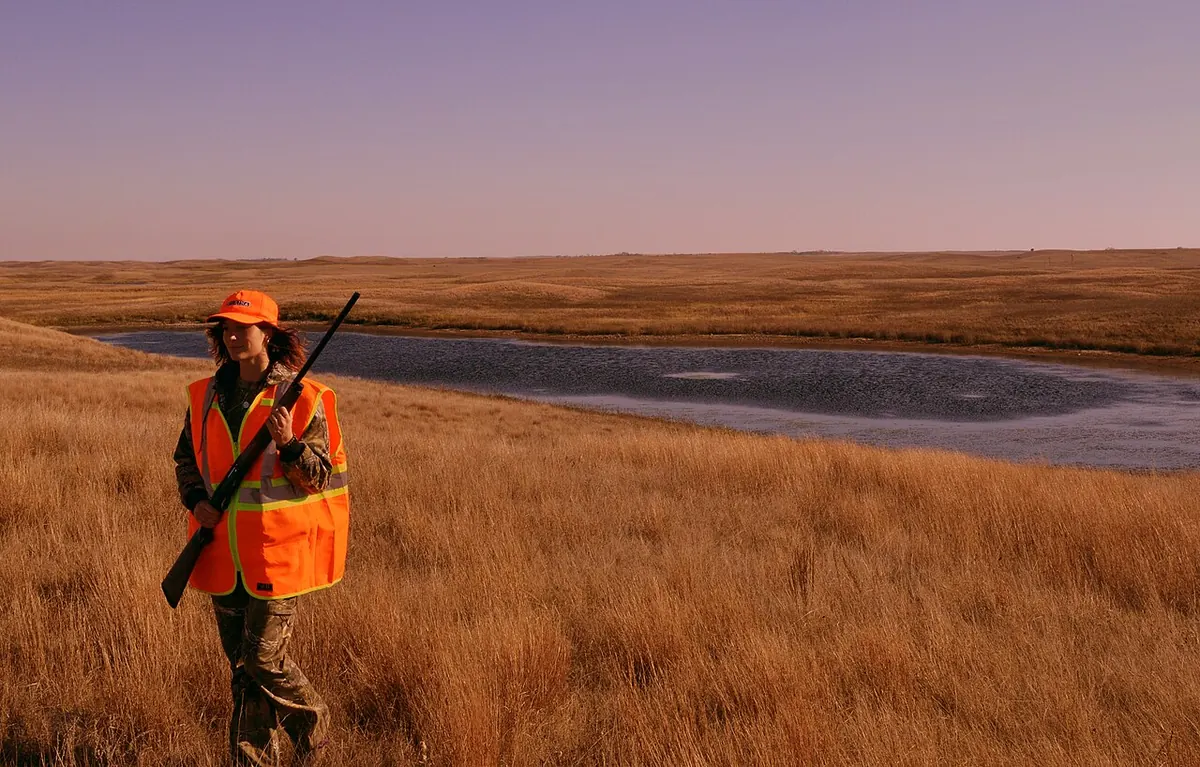
 Photo U.S. Fish and Wildlife Service, Midwest Region, Public domain

Carrying a firearm in the field
The carries, which one to use with people ahead, behind or beside you, and how to get a firearm over a fence, up a bank and into a boat.
What you need
- A sling
- Hunter orange
- A length of cord to haul an unloaded firearm up a bank
- Your licence and the current regulations
The carries
- Two hand carry: both hands on the firearm, muzzle up and ahead. The most control and the fastest to the shoulder. Use it when game could be close.
- Sling carry: on the shoulder, muzzle up. Good for walking a trail, poor in thick brush where branches catch it.
- Trail carry: one hand at the balance, muzzle ahead and down. Only when nobody is in front of you.
- Cradle carry: across the forearm, muzzle to the side. Only when nobody is on that side.
- Elbow carry: a break action open over the forearm, muzzle down. The safest carry there is, since the gun cannot fire.
- Shoulder carry: on the shoulder, muzzle up and behind. Only when nobody is behind you.
- Pick the carry that keeps the muzzle away from every person, and change it every time they move. Walking side by side, point outward. In single file, the lead points ahead and the rest point off to the side.
Fences, banks and boats
- Unload before any fence, ditch, bank or deadfall.
- Alone at a fence: lay the firearm on the ground on the far side, muzzle pointed away from where you will cross. Cross well away from the muzzle, then pick it up.
- With a partner: one holds both firearms, actions open, while the other crosses. Hand them over the fence one at a time, then the second person crosses.
- Up a steep bank or into a stand: tie a cord to the unloaded firearm, climb with both hands free, and haul it up muzzle down.
- Into a boat or a canoe: unloaded, action open. One person holds the boat, the firearms go in last with the muzzles pointed away, and nobody stands to reach for one.
- Unload before it goes on a quad, a snowmobile or in the truck. A loaded firearm in or on a vehicle is against the law.
Do and don't
Do
- Agree before you set out who covers which side, and stay in your own zone.
- Keep your finger outside the trigger guard and the safety on until you are ready to shoot.
- If you fall, control the muzzle first, then check the barrel for snow or mud before you go on.
Don't
- Do not lean a firearm against a tree, a fence or a vehicle. It falls.
- Do not use a rifle scope to look at something you have not identified. Use binoculars.
- Do not climb, jump or cross anything with a loaded firearm.
Watch for
Danger
- Brush can push the safety off and catch the trigger. Check the safety often in thick cover.
- A sling can slide off the shoulder and swing the muzzle across the people beside you.
- Ice, wet rock and moss take your feet out from under you. Most field accidents happen on the way in and out, not at the shot.
Notes
The right carry changes every time your partner moves. Keep checking where the muzzle points and where the people are.
See Safe gun handling, Storing and moving firearms and Hunter orange and being seen.
Updated 2026-09-29
Related
 Matching ammunition
Firearms
The right cartridge for the gun every time, and how to keep ammunition dry, sorted and apart from the guns.
 Safe gun handling
Firearms
The rules that never change, and where storage and transport sit.
 Cleaning a rifle
Firearms
A safe, simple clean after the range or the hunt, and keeping a rifle working through wet and cold.
 Shotgun basics
Firearms
Gauges, chokes and shells, and patterning the gun so you know where it throws its shot.